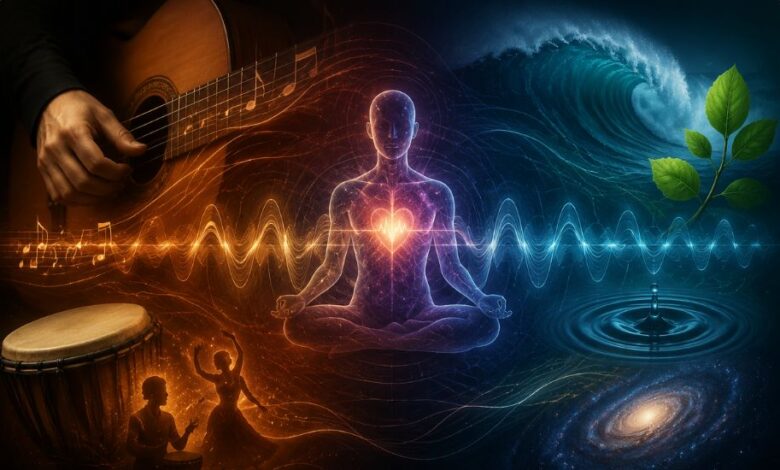
In both music and nature, there is an invisible structure that gives movement its sense of life and continuity. It is not always a measurable beat or a strict pattern, but something more fluid and deeply felt. This concept is often described through the term pulsamento, which refers to an underlying rhythmic pulse that connects sound, motion, and emotion. It can be heard in music, observed in natural cycles, and even experienced in human behavior and creativity. Rather than being a fixed technical rule, it represents the living essence of rhythm itself—something that exists beneath surface-level structure and brings coherence to everything that moves in time.
Meaning and Origins of Pulsamento
The idea of pulsamento is rooted in the Latin verb pulsare, meaning “to strike,” “to beat,” or “to pulse.” Over time, this linguistic root evolved into interpretations used in artistic and musical contexts, where it came to describe a continuous rhythmic force rather than a single beat.
Unlike strict musical terminology such as tempo or meter, the concept is more abstract. It refers to the internal motion that drives rhythm forward, even when it is not explicitly measured. In this sense, pulsamento is less about calculation and more about perception. It represents how rhythm is felt rather than counted.
In modern interpretations, it is often used to describe the emotional continuity of sound or movement, bridging the gap between technical rhythm and expressive flow.
Pulsamento in Music Theory and Performance
In music, pulsamento plays an essential role in shaping how rhythm is experienced by both performers and listeners. While tempo provides structure, it is the underlying pulse that gives music its emotional depth and coherence.
Musicians often rely on this internal sense of rhythm to stay synchronized, especially in ensemble settings where precision alone is not enough. It influences timing, phrasing, and dynamic expression, allowing music to feel alive rather than mechanical.
In classical and flamenco guitar traditions, the term is also associated with right-hand techniques that involve controlled plucking patterns. These techniques create flowing arpeggios and rhythmic textures that give the impression of continuous motion. The result is a sound that feels organic, where each note contributes to a larger rhythmic wave rather than standing alone.
Beyond instruments, vocal performance also relies on this principle. Singers naturally adjust phrasing based on internal rhythmic awareness, ensuring that emotional delivery aligns with the underlying structure of the composition.
Scientific and Natural Interpretation
Outside of music, pulsamento can be understood as a broader natural principle related to cycles, oscillations, and repetition. Many biological and physical systems operate through rhythmic patterns that resemble this idea.
The human heartbeat is one of the most direct examples. It is not just a mechanical process but a rhythmic cycle that sustains life. Similarly, breathing follows a continuous pattern of expansion and release that mirrors musical phrasing in surprising ways.
In neuroscience, brain activity also operates in rhythmic waves. These oscillations influence attention, emotion, and perception. Even sleep cycles and circadian rhythms follow structured repetition that governs biological balance.
Nature also reflects this principle through ocean tides, seasonal cycles, and ecological patterns. These systems do not function as isolated events but as continuous flows of energy and change. In this sense, pulsamento can be seen as a universal principle of rhythm embedded in both living and non-living systems.
Artistic and Cultural Usage
Artists, writers, and designers often use rhythmic flow as a foundation for creative expression. In this context, pulsamento becomes a metaphor for artistic energy rather than a technical term.
In visual arts, it can describe the way composition guides the viewer’s eye through repeated shapes, colors, or movement patterns. In literature, it may refer to the rhythm of language—the rise and fall of sentence structure that shapes emotional tone.
Modern digital culture has also adopted this idea in broader ways. Creative branding, motion design, and multimedia storytelling often rely on rhythmic consistency to create immersive experiences. The sense of flow between elements helps audiences feel connected to the content, even without consciously recognizing the underlying structure.
This cultural expansion shows how rhythm is not limited to sound alone but extends into every form of human expression.
Practical Understanding in Daily Life
Although it originates in artistic and theoretical contexts, the idea behind pulsamento can also be applied to everyday life. Human actions often follow subtle rhythms, from daily routines to emotional cycles.
For example, productivity often fluctuates in natural waves rather than remaining constant. Recognizing these internal patterns can help improve focus and balance. Similarly, physical activities such as walking, breathing, or exercising naturally align with rhythmic flow.
Meditation and mindfulness practices also rely heavily on controlled breathing patterns that stabilize attention. By becoming aware of internal rhythm, individuals can create a sense of calm and consistency in their mental state.
Even communication carries rhythm. Conversations have timing, pauses, and emphasis that shape meaning beyond words. Understanding this flow can improve both expression and listening skills.
Pulsamento vs Rhythm and Pulse
Although related, these concepts are not identical.
A pulse is a single repeating beat, often mechanical or measurable. Rhythm refers to a structured arrangement of beats over time. Both are technical and can be quantified.
Pulsamento, however, is more experiential. It refers to the feeling of continuity that exists between beats. It is not confined to strict measurement but exists in perception and interpretation.
Where rhythm is structure and pulse is repetition, pulsamento is flow. It is what connects individual moments into a unified experience, making sound, movement, or life feel continuous rather than fragmented.
Why It Matters in Creative Work
In creative fields, understanding this concept can significantly influence how work is designed and experienced. Whether in music production, visual design, writing, or performance, rhythm plays a central role in engagement.
When creators focus only on structure, their work may feel rigid. When they incorporate flow and internal movement, the result becomes more immersive and emotionally resonant. This balance between control and fluidity is what gives creative work depth.
It also helps bridge technical skill with emotional expression. A technically correct composition may still feel lifeless if it lacks internal rhythm. Conversely, work guided by flow often feels natural and compelling, even with minimal structure.
The concept of pulsamento ultimately serves as a reminder that rhythm is not only something we measure but something we experience. It exists in sound, nature, thought, and emotion, shaping how we perceive continuity in the world around us. By understanding this deeper layer of rhythm, creators and thinkers can develop a more intuitive connection to their work and environment.
This article is published on Digi Blogs.