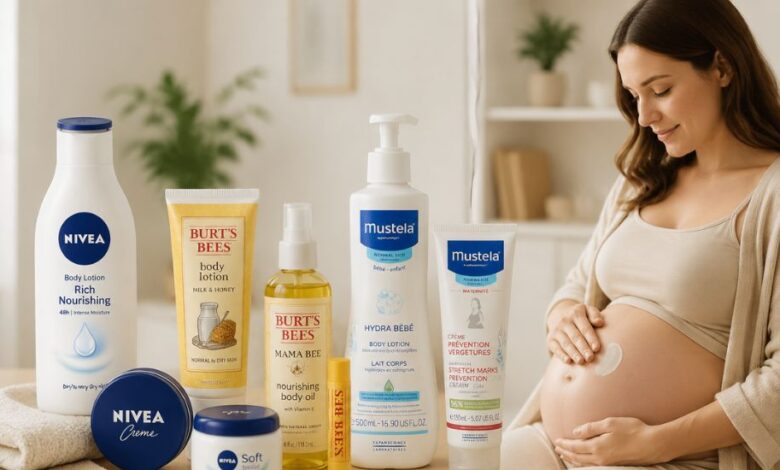
Pregnancy often brings a complete shift in skincare habits. Products that once felt harmless suddenly raise questions about safety, ingredients, and long-term effects on both mother and baby. Among the most commonly compared brands in this space are Nivea, Burt’s Bees, and Mustela, each offering different philosophies toward skincare. While Nivea is widely known for its classic moisturizers, Burt’s Bees emphasizes natural-origin ingredients, and Mustela is positioned specifically for maternity and baby care. Understanding how they compare helps expectant mothers make informed, confident choices without unnecessary confusion.
For most people, skincare during pregnancy is not about switching to completely new routines but about identifying which products remain gentle enough and which ingredients should be avoided. The real answer is less about brand reputation and more about formulation details.
Understanding Skincare Safety During Pregnancy
During pregnancy, skin can become more sensitive due to hormonal changes. This may increase dryness, pigmentation, or irritation. Because of this, dermatologists generally recommend focusing on gentle, fragrance-light, and well-formulated products.
The most important factor is ingredient awareness. Certain compounds are commonly advised against during pregnancy, including retinoids (vitamin A derivatives), high-strength salicylic acid, hydroquinone, and some essential oils in concentrated forms. These ingredients are not necessarily present in all skincare products, but they can appear in anti-aging or treatment-focused formulations.
At the same time, many basic moisturizers, cleansers, and body lotions are considered safe when they contain simple hydrating ingredients like glycerin, shea butter, or ceramides.
Nivea Products During Pregnancy
Nivea is one of the most widely used skincare brands globally, known for its moisturizing creams, body lotions, and lip care products. In general, most basic Nivea products are considered safe for use during pregnancy when used as directed.
Simple formulations such as classic moisturizers and body lotions mainly focus on hydration rather than active treatment ingredients. These products typically rely on emollients and moisturizers that help maintain skin barrier function, which can be beneficial during pregnancy when dryness is common.
However, not all Nivea products are identical. Some anti-aging lines or specialized formulations may include active ingredients aimed at reducing wrinkles or improving skin texture. In such cases, it becomes important to check for ingredients like retinol or strong chemical exfoliants, which are generally avoided during pregnancy.
Fragrance content is another consideration. Some Nivea products contain added fragrance, which may be tolerated well by many users but could trigger sensitivity in pregnant individuals with heightened skin reactivity.
Overall, Nivea is best viewed as a generally safe option for basic skincare, provided that product selection is done carefully.
Burt’s Bees and Natural-Based Formulations
Burt’s Bees is often associated with natural-origin ingredients and eco-conscious skincare. Many of its products include botanical oils, beeswax, and plant-based extracts, which appeal to individuals seeking a more natural routine during pregnancy.
In general, Burt’s Bees products are also considered safe for pregnancy use, especially their simple moisturizers, lip balms, and body care items. However, the assumption that “natural” automatically means safer is not always accurate.
Certain plant extracts and essential oils can still be irritating or overly stimulating for sensitive skin. Ingredients such as citrus oils or strong botanical blends may not be suitable for everyone, particularly during pregnancy when skin sensitivity is heightened.
Another factor to consider is fragrance. Even naturally derived scents can sometimes cause irritation. Therefore, while Burt’s Bees aligns with a more natural skincare philosophy, ingredient evaluation remains essential rather than relying solely on brand perception.
In short, Burt’s Bees offers pregnancy-compatible options, but careful product selection is still necessary.
Mustela and Pregnancy-Focused Skincare
Mustela stands out from both Nivea and Burt’s Bees because it is specifically developed with maternity and baby skincare in mind. This focus gives it a different positioning in terms of formulation philosophy.
Many Mustela products are designed to be hypoallergenic, with reduced risk of irritation. They often prioritize dermatological testing and use milder preservatives and fragrance systems compared to conventional skincare brands. This makes Mustela a strong choice for individuals looking for pregnancy-targeted skincare solutions.
One of Mustela’s key strengths is its emphasis on products for stretch mark prevention and skin elasticity support. These products are formulated with pregnancy needs in mind rather than general skincare concerns.
However, even within Mustela’s range, it is still important to read product labels. No skincare brand is completely uniform across all its products, and sensitivity can vary from person to person.
Overall, Mustela is often considered the most pregnancy-specialized option among the three.
Direct Comparison of Nivea, Burt’s Bees, and Mustela
When comparing these three brands side by side, the differences become clearer based on formulation approach rather than branding alone.
Nivea focuses primarily on hydration and general skincare, making it a widely accessible option for basic moisturizing needs. Burt’s Bees leans toward natural-origin ingredients and appeals to users who prefer plant-based formulations, although it still requires careful ingredient awareness. Mustela is the most pregnancy-oriented brand, designed specifically with maternity and baby skin considerations in mind.
From a safety perspective, all three brands can be used during pregnancy when the correct product types are chosen. The deciding factor is not the brand itself but whether the specific product contains ingredients that are considered unsuitable during pregnancy.
Ingredients to Avoid or Limit During Pregnancy
Regardless of brand choice, certain ingredients are commonly advised against during pregnancy. These include retinoids such as retinol, which are widely used in anti-aging skincare. High concentrations of salicylic acid and hydroquinone are also typically avoided due to their potency.
Some essential oils, particularly in high concentrations, may also cause sensitivity or irritation. While not all essential oils are problematic, their use in skincare during pregnancy should be approached cautiously.
Understanding these ingredients helps in evaluating any product, whether it belongs to Nivea, Burt’s Bees, or Mustela.
Choosing the Right Skincare Approach During Pregnancy
The safest skincare routine during pregnancy is usually simple and consistent. Gentle cleansing, regular moisturizing, and avoiding aggressive treatments are often enough to maintain healthy skin.
Rather than switching entirely to one brand, many individuals prefer combining products based on need. For example, a basic moisturizer from Nivea, a lip balm from Burt’s Bees, and a stretch mark cream from Mustela can all be part of a balanced routine.
The key principle is moderation and ingredient awareness rather than brand loyalty.
Pregnancy skincare decisions should always prioritize comfort, safety, and simplicity, ensuring that the skin remains supported throughout the changing stages of pregnancy. This article is published for informational purposes on Digi Blogs.